

Summary
- Sovereign debt markets have obviously been fragile. We explore some potential drivers and assess their durability
- This fragility is increasing the importance of political outcomes for markets. The political choices that countries make look set to have a larger impact on investors than in the last cycle
- French, Spanish, Italian and German political developments are becoming important
- Whilst the centre of action is in bonds, there are signs that this cost of capital shock is spilling over into equities
Valuation Update
There is a lot of confusion about what has driven the broad weakness in sovereign bonds. Is it debt levels, fiscal deficits, inflation, real growth, the term premium, demographics, central bank policy, the oil price – or something else?
We briefly go through some of the drivers below:
Debt levels
G7 Debt to GDP has been rising since 1979, and is heading north of 120% in the aggregate. This is clearly a high number, but some say, why should this level suddenly matter now?
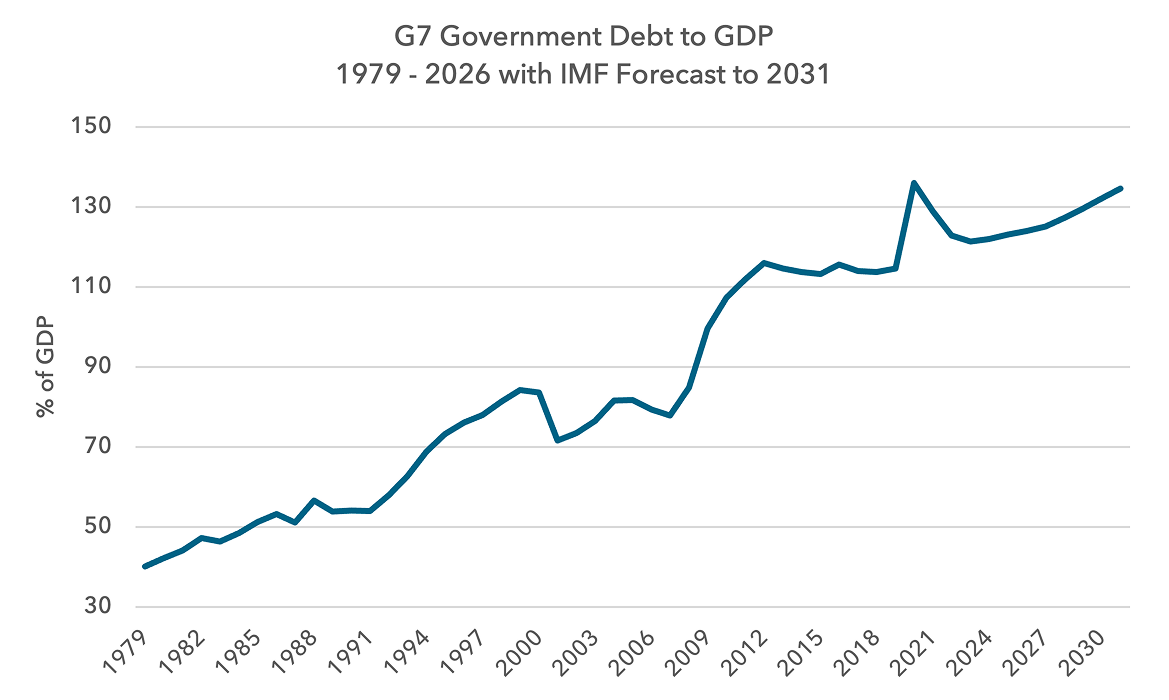
Source: IMF World Economic Outlook, October 2026
Fiscal Deficits
Fiscal deficits are wide, especially given most economies are at full employment. Historically, at full employment, most advanced economies would be at a surplus, or close to it. If we have a recession, many countries could see fiscal deficits rise to 10-20% of GDP.
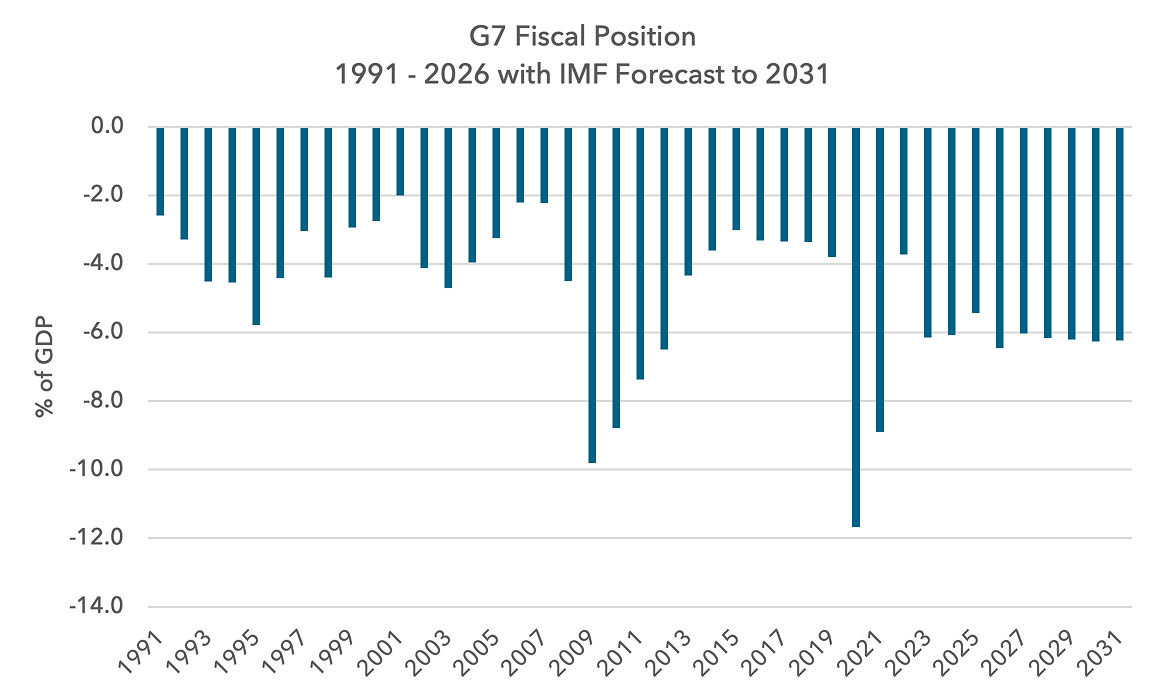
Source: IMF World Economic Outlook, October 2026
As we know, fiscal consolidation is difficult, due to ageing populations and geopolitical tension driving up defence spending, especially in Europe.
But we are not yet in recession and deficits have briefly been wider in the past, leading some investors to question why today’s deficit level should matter.
The term premium
The term premium is moving higher, meaning investors are demanding compensation, over and above today’s perception of inflation and growth, to own government bonds. This level, measured by the New York Fed, has averaged 1.4% since 1961. Today it is around 1%, having been negative two years ago. Whilst the absolute number is low relative to history, the rate of change is steep, suggesting bond investors are losing confidence quickly.
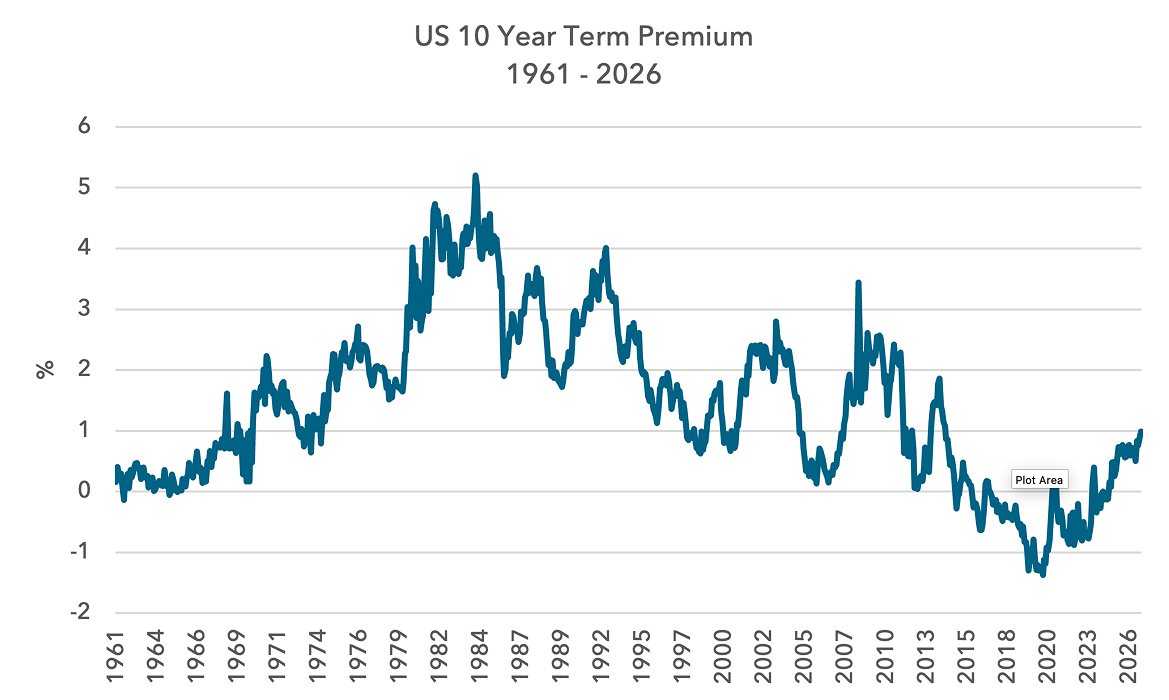
Source: Federal Reserve Bank of New York (ACM term premium)
Demographics
China and high-income countries have oscillated between small increases and decreases in the working population over the last decade. But in 2027 we move to a decisive and persistent working-age population decline. Whilst there is still population growth in the rest of the world, this deficit in workers in China and advanced economies may lift labour’s pricing power, and so lift inflation and yields, all else equal.
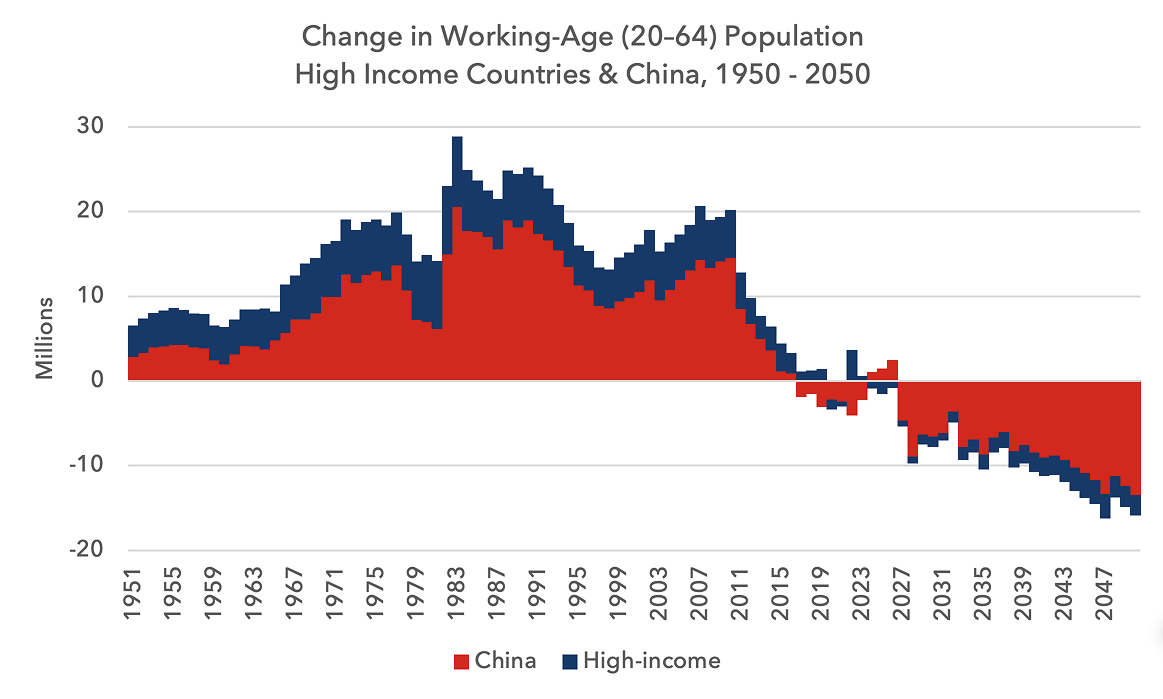
Source: UN World Population Prospects 2024
Changes in Savings Rates
This change in demographics also changes the path of global saving. For most people in advanced economies, savings rates peak from the age of 40-64, when earnings are highest, and expenses like housing or childcare start to taper down.
As we all know, as people retire, they draw down their savings. Today there is a large cohort of baby boomers retiring, leading to a large potential reduction in the pool of global savings.
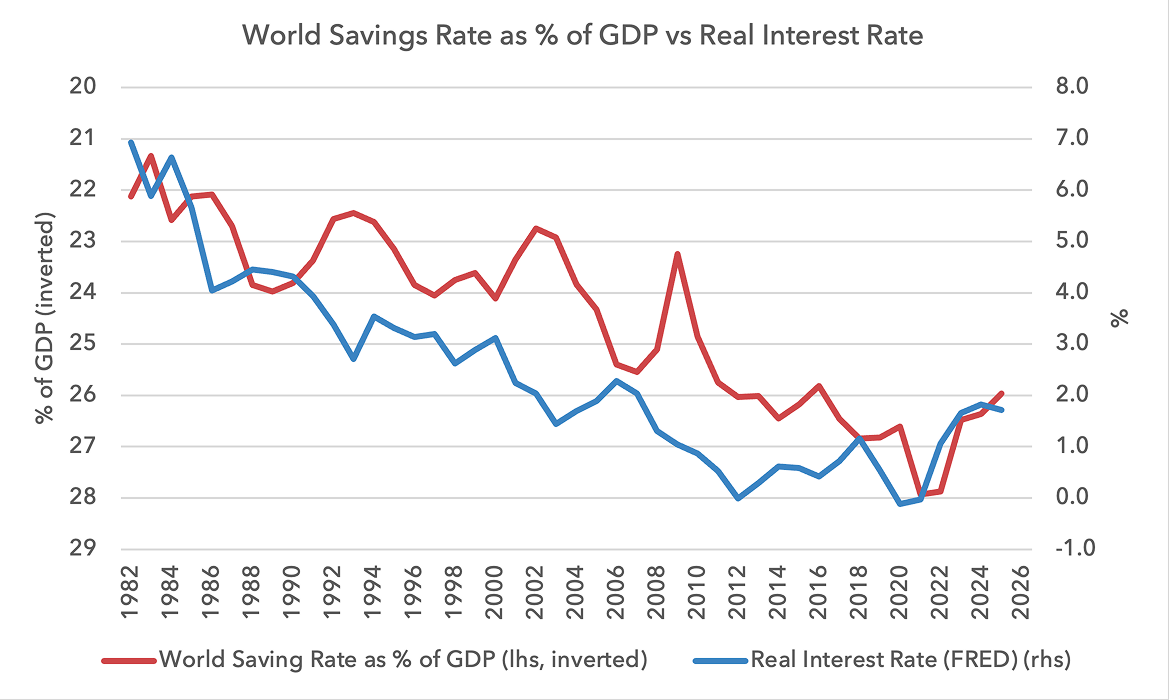
Below we show the IMF’s world savings rate from their World Economic Outlook, and show it alongside the Cleveland Fed’s 10-Year real interest rate. We show the entire period of the great bond bull market, starting in 1982.
In this chart, the savings rate is inverted, and so as savings rise, yields fall, and as savings fall, yields rise.
Sources: IMF World Economic Outlook; Federal Reserve Bank of Cleveland via FRED
The long-term demographic outlook for increased retirees suggests global savings rates might continue to fall, and so put upward pressure on real rates.
This thesis was well articulated by Goodhart and Pradhan in their book The Great Demographic Reversal. As they also note, government deficits are another form of dissaving. If you assume governments will continue to spend, in some cases due to these demographic shifts, then this is another force pushing savings rates down, and yields up.
Investment boom
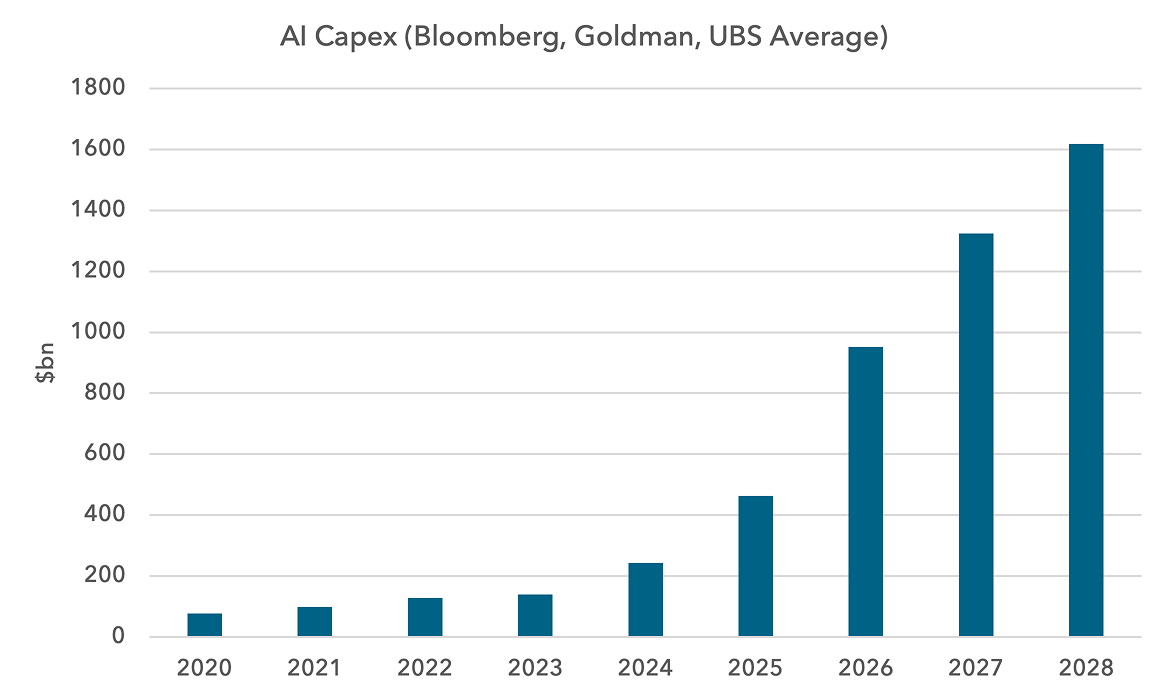
We have all seen the AI capex charts.
Sources: Bloomberg, Goldman Sachs, UBS
Whilst the dollar numbers look large, global AI capex is about 1% of global GDP, so the amount of spending, taken in isolation, is unlikely to significantly impact rates.
But most of this spending is being funded by debt issuance, so this increased supply of debt securities is likely crowding out other debt markets to some degree. The early phase of the investment cycle is also inflationary, and this might be putting further upward pressure on yields.
This would suggest that a sharp reversal in AI capex could also help to pull yields down, at least in the short run.
Oil price and central bank policy
A decline in the oil price and fewer rate hikes will clearly put cyclical downward pressure on yields, and reduce some bond market pressure. In the short term, there are too many moving parts with respect to oil and Fed policy to make strong conclusions about this path.
But it is worth noting that we appear to be in a period of resource nationalism, within the wider great power rivalry between the US and China. All of the US’s recent significant foreign policy initiatives can be understood in the context of control of raw materials. With Venezuela and Iran the focus was energy, but the tie-ups with Bolsonaro and Milei in Latin America show this may also be extending to agriculture. This attempt to control the flow of commodities adds a risk premium to the sector broadly, which may sustain an inflationary impulse in the global economy over time.
AI Productivity
All of the above forces appear to be pushing yields up. What about the forces pushing yields down? Aside from recession, inflation doves assume that AI will lead to higher labour productivity and reduced employment over time. There is tentative evidence of this in segments of the economy. Higher productivity is appearing and entry-level white collar employment has been weaker.
If labour is no longer scarce, thanks to AI and robotics, then some of the demographic driven arguments noted above will be countered. But the question that follows this scenario is: what is the political response? AIs do not vote, but people do. We assume the political response to a significant AI driven job displacement will require more government spending. Bigger fiscal deficits and more bond issuance may follow. And so we return to forces with the capacity to put upward pressure on yields.
The primacy of politics
It is hard to pinpoint one specific driver of sovereign bonds. The most noteworthy element from the section above is the sheer volume of forces that appear to be pushing interest rates higher structurally.
Short term, a lower oil price, a recession, or an AI capex reversal will help to lower yields. But this structural backdrop suggests that it will take more to lower yields decisively than we became used to in the last cycle. From 1982-2020, all of the forces listed above were in the opposing direction and so yields broke lower easily. Today it appears to be the reverse; it takes relatively little to cause yields to move higher.
The Liz Truss related bond sell-off in 2022 was notable, not because of the policy proposals, but because of the market reaction. The proposals were not outlandish, but the sell-off was severe, because so many structural forces were gathering to push yields up.
We appear to be in an era of extremely high market sensitivity to elections and political decisions. Political missteps are punished by the bond market, more quickly and violently than in the last 40 years. It follows from this that politics may be taking on a more important role in markets, perhaps more powerful even than economics. And so we believe we need to spend more time thinking about the political cycle.
European Sovereign Spreads
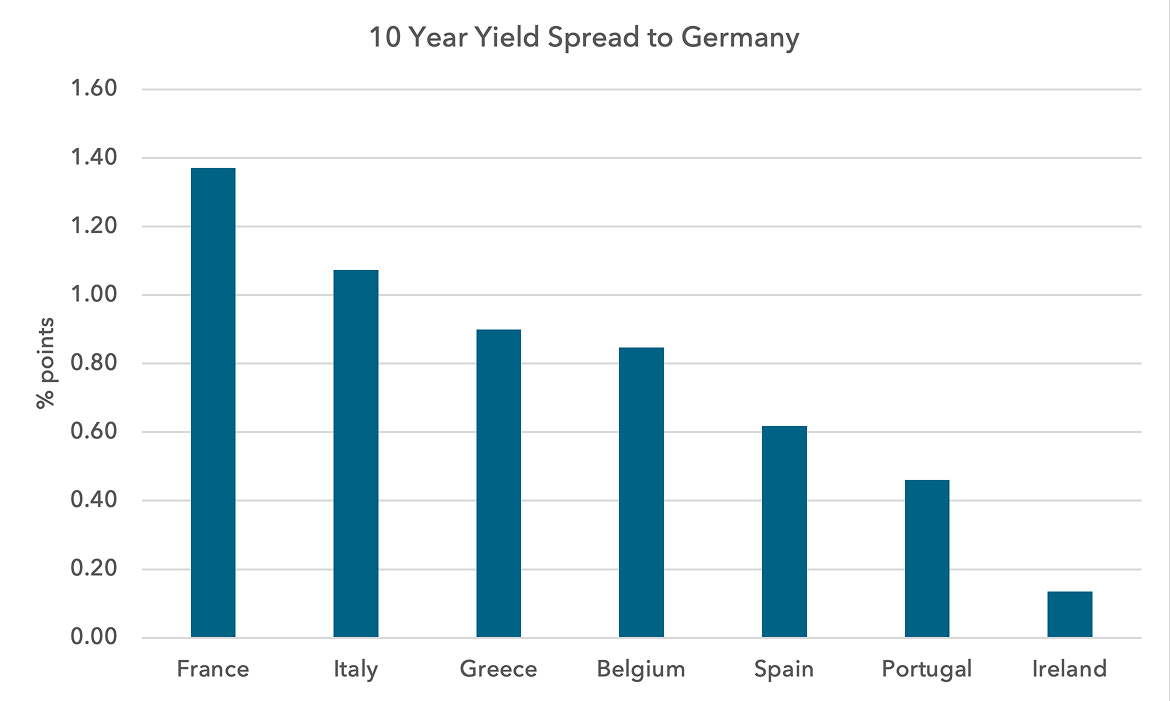
The 10 year yield spread over German Government bonds is a well-used benchmark to view the market’s perception of sovereign risk in Europe. The higher the spread, the higher the perceived risk. A sharply widening spread amounts to a cost of capital shock for those countries affected, that can impact future credit risks and potentially growth. At the time of writing, this is the current market pricing:
Source: Bloomberg
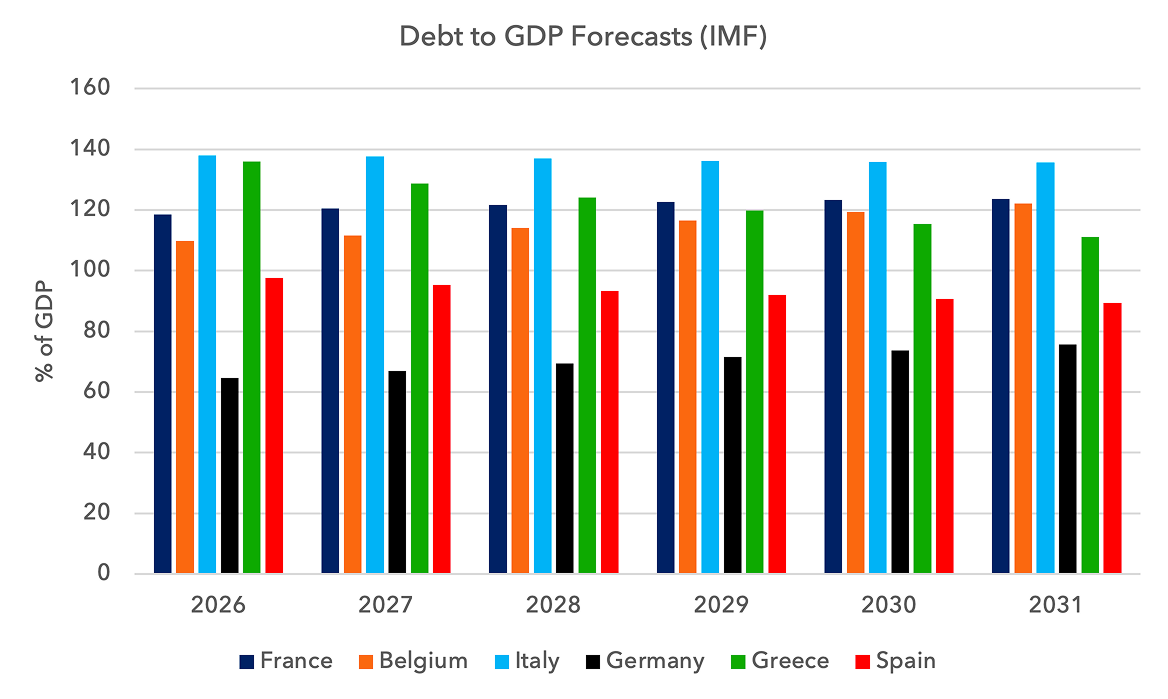
Key drivers of this spread are the overall debt to GDP and the fiscal position. The latest IMF projections for select EU countries from their October 2026 World Economic Outlook are below:
Source: IMF World Economic Outlook, October 2026
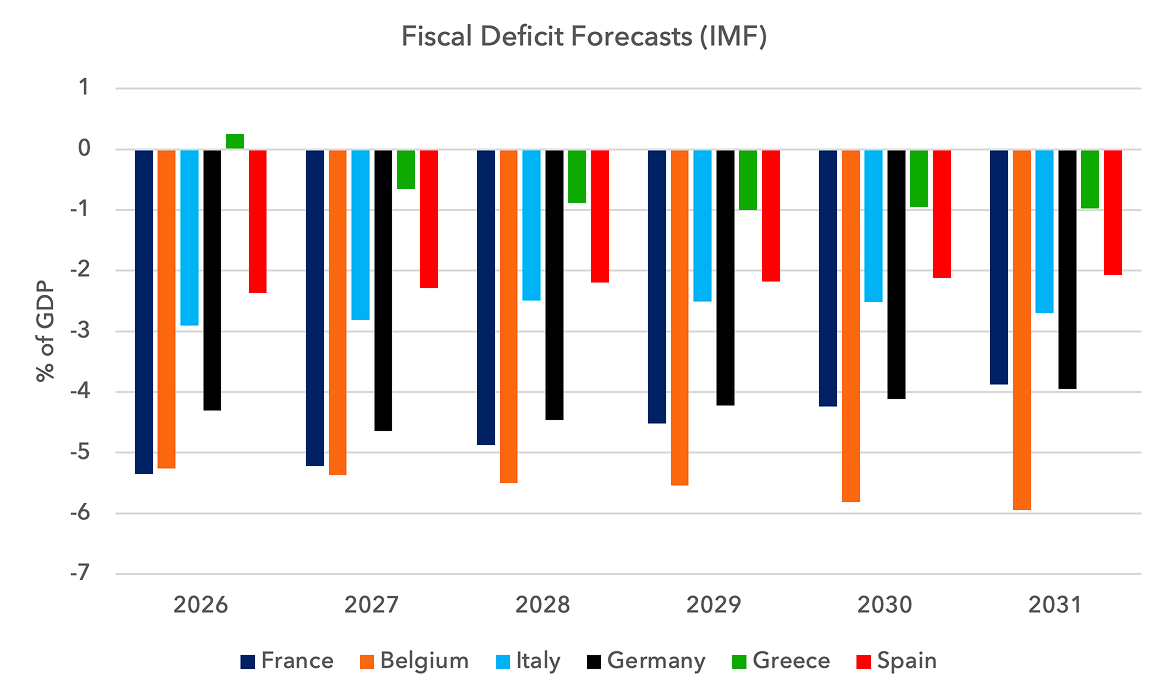
Source: IMF World Economic Outlook, October 2026
The European political cycle
In Europe we have numerous elections coming up, that have the potential to be powerful drivers of sovereign debt markets.
We provide a brief update of these below. We will focus on France, Spain, Italy and Germany – but beforehand, it is worth briefly mentioning Belgium and Greece.
Belgium
Belgium has very weak fiscal metrics, weaker than France. It has escaped investor attention because there are no elections until 2029 and there is no significant populist front runner. Belgium is also a net creditor to the rest of the world with a large pool of domestic savings, and also has a long maturity of its bonds. That being said, it is likely that it will get caught up in any wider sovereign risk contagion, and it could be argued that spreads should be closer to French levels than they are today.
Greece
Greece has improved their fundamentals significantly. They have run significant primary surpluses for years and so are seeing their debt levels decline sharply. Debt to GDP is set to fall to 129% in 2027, from 210% in 2020 – an incredible achievement. Greece has been greatly helped by the fact that much of its debt is held by Euro area bailout funds and this debt has low interest rates and long maturities. There are Greek elections in the spring of 2027, which are worth monitoring, but there is no obvious significantly disruptive path ahead. Today New Democracy (right) lead in the polls with Tsipras’ ELAS (left) in second, and Pasok (centre) in third.
France
Key dates: Presidential Election first round 18 April 2027. Run-off final round 2nd May.
France is in a vulnerable position because of the size of their total debt and the size of their deficit. They would need to run a deficit of around 3% of GDP to stabilise their debt levels, vs the near 6% today.
Before the elections we have negotiations on the French budget, which are ongoing. The budget is unlikely to be voted through parliament given the lack of a majority, but France has some particular constitutional loopholes that can enable it to pass legislation without a vote. Some of these carry risks of a no confidence vote afterwards. The ebbs and flows of these budget negotiations will likely dictate bond spreads over the coming months.
Today investors are particularly worried because the two front runners in the presidential election seem worrying: Marine Le Pen of the RN on the hard right and Jean-Luc Mélenchon of LFI on the hard left. But it is worth stating that there is no single centrist candidate agreed yet. Today Édouard Philippe and Gabriel Attal are both aiming for this spot and are splitting the vote. If the centre cannot agree on one candidate we will likely get Le Pen vs Mélenchon in the second round. If it can, we may see a tighter race with a centrist, with Le Pen still favoured to win the run-off.
If Le Pen wins, she would not have a majority in the National Assembly and so at the outset, her ability to control fiscal policy would be limited. But if she were to dissolve the Assembly and call legislative elections, then we could see her party having the potential to win an absolute majority. The earliest this could happen would be mid-June 2027.
What might this mean for French bond markets?
Le Pen has made some recent commitments towards fiscal restraint that are worth highlighting. She has pledged to run a primary balance within 18 months of taking power, and bring the deficit back to 3% by 2030. She has proposed a golden rule to force a debt reduction every year, and targets debt of 112% of GDP by the end of her term.
This opens the door to a Meloni-type situation, where market anxiety is not matched by reality. The problem is she wants to bring the retirement age back to 60 from 62, and to reduce taxes. Her savings are supposed to come from reducing France’s contribution to the EU budget and reducing benefits paid to foreigners who have not lived in France for 5 years.
It is hard to square her savings commitments with her actual proposals, the numbers do not add up.
If legislative elections were held and the RN could not muster a majority in the Assembly, France would enter a period of “cohabitation” with different parties controlling the Presidency and the Assembly. But this scenario is not helpful for markets, given the current fiscal position requires action.
As we will see for all of these countries, the fiscal outlook reflects the will of the people. To state the obvious, unless the population wants fiscal consolidation, it is not likely to happen. Something would need to change whereby the electorate sees austerity and fiscal consolidation as being in their interests. We do not appear to be at that point today.
Spain
Key date: General Elections 29th November 2026
Prime Minister Pedro Sánchez of the PSOE called a snap election due on 29th November, after two important housing related bills were rejected in Congress. Today based on current polls, a right wing coalition is possible, with the PP and Vox potentially winning a majority.
A PP and Vox coalition is likely to cut taxes and lower immigration. This will widen the deficit in the short run, but from a healthier starting point than France or Italy. Spain is set to run a deficit of 2.6% of GDP in 2026 and debt is expected to fall to 99%.
Spain’s high immigration has been a significant driver of its economic outperformance in recent years. The Bank of Spain estimates that immigration added 1.7% of Spain’s 3.7% average GDP growth from 2022-2025. A cut in immigration will lower Spain’s growth rate, which may also weaken the fiscal position.
Most investors are relatively sanguine about a change in political power in Spain, but spreads did widen on the announcement of the election. The consensus is that a right wing leadership will be a safer bet than today’s left wing. This may be true, but tax cuts that are too aggressive, or an inconclusive election, could see spreads widen further.
Italy
Key date: General Election by 22nd December 2027
Italy has performed quite well in recent years, running a primary surplus since 2024, keeping their debt to GDP stable. Italy is hoping to run a deficit of less than 3% in 2026, although there is some increase forecast next year, based on the EU allowing for more spending on defence and energy.
In current polling the centre left and centre right coalitions are at similar levels, around 40-43%. A new constitutional law allows for the party grouping that achieves 42% or more of the vote to get a bonus of 70 seats, allowing for a parliamentary majority.
Meloni’s Brothers of Italy group have the chance to get to the 42% needed, if they include a new hard right party led by Roberto Vannacci. But Vannacci is problematic and there are allegations that he is a Russian stooge. He served as Italy’s defence attaché in Moscow from 2021-2022 and his positions are aligned with Russian interests.
Italy has three paths: a Meloni led centre right coalition, a centre left coalition, or a hung parliament where no grouping reaches 42%. Italy has been in each of these scenarios before, and the fiscal outcomes were not particularly different between the three. On balance, all election outcomes appear to lead to a marginally less secure outcome for the bond market than today. Spreads could move wider as the election approaches, but perhaps the more dominant force will be the global sovereign debt picture, and the trajectory of the global economy.
Germany
Key dates: 18 April 2027 Schleswig-Holstein and Saarland state elections. 25 April 2027 North Rhine-Westphalia state election
Germany does not have Bundestag elections until spring 2029, but has a very precarious coalition government. Merz’s CDU party polled very poorly in the recent state elections in Saxony-Anhalt on 6 September, and the AfD performed strongly. Merz may be replaced early next year if the CDU do poorly in the state elections in the first half of 2027.
There are also budget and pension reforms that are due to be voted on in the coming months that will test the unity of the coalition.
If Merz is replaced, it will most likely be after the North Rhine-Westphalia elections on 25th April. This is Germany’s most populous state and it is currently run by Merz’s most likely successor, Hendrik Wüst. If the CDU do poorly but Wüst outperforms the party, Merz may well be replaced.
Hendrik Wüst is much more popular than Merz and is seen as a better candidate to halt the rise of the AfD. The AfD are leading in the polls but at about 28%, with the CDU at 19%, the Greens at 15%, the SPD at 13% and Die Linke at 11%.
The AfD’s rise is striking, but no meaningful party, including the CDU, is willing to serve in a coalition with them as of today, and so their path to power looks challenging.
The AfD is evolving and is taking steps to become more acceptable. Like Marine Le Pen in 2019, the party has just decided to abandon their demands for Euro exit. Euro membership is simply too popular in Germany. This change of tack slowly improved Le Pen’s popularity in France, and it may do the same for the AfD. It could also be a small step that increases the possibility of them being accepted by the CDU in a coalition in future.
With respect to sovereign debt markets, Germany has committed to sharply increase spending. Given general elections are not likely until 2029, this deterioration of their fiscal position looks locked-in. Their budget deficit is rising from 2.5% in 2025 to 5% in 2027, with debt to GDP rising from 63% to 78% over the same period.
Germany as anchor for the EU
Germany has always been the anchor for European sovereign yields and so higher German yields may lead to higher yields across the Eurozone.
Germany’s anchoring effect has worked through different dimensions, but each relies on its balance sheet. The first is from Germany’s budget transfers to the EU, where they send a net €13-€20bn per year to the central EU budget. The second is through EU and ECB support mechanisms, like joint borrowing, the European Stability Mechanism (ESM) or the Transmission Protection Instrument (TPI). Whilst a lot of these are contingent promises, their efficacy relies on the strength of Germany’s balance sheet and willingness to provide it.
The AfD are vocal in aiming to reduce Germany’s commitments to the ECB, and this view is becoming popular. This has some logic given Germany’s export driven growth model is now facing serious challenges. Germany is not in a position to be as generous to the rest of the EU as it was in the past.
A weakening environment for sovereign debt
In the short run, sovereign debt market anxiety may have reached an interim crescendo. A lower oil price, weaker economic growth or a major AI wobble could see yields fall. But we face a challenging period in 2027. Germany’s fiscal position is weakening just as we reach a peak in French political risk, with Italian elections also imminent.
Investment implications
As we have written about before, we view a rising cost of capital as a problem for equity valuations. Value investing ought to provide significantly more protection than growth investing in this environment.
The nuance comes from the outlook for European banks. Banks make up a large part of the value benchmark and are well held by value funds. We no longer like the outlook for Euro-area banks and have zero exposure. Our only bank holdings are in two Scandinavian institutions. Whilst valuations for the banks are not very high and capital positions are solid, we do not see a strong enough outlook for their earnings. We assume the rise in the risk free rate will start to permeate other credits at some point, and also constrain loan growth.
We are also surprised at the market’s confidence about economic growth. We have seen a material tightening of financial conditions. Many European companies that operate in more defensive industries like Consumer Staples have significantly de-rated in recent years. We find value in owning some companies that are in a solid position to withstand higher economic volatility that might be ahead.
How might this backdrop change?
Government spending plans need to change, with deficits reduced and debt metrics stabilised. But this does not appear likely for the time being. Stating the obvious, no change will take place until the voting populations want it.
So far, there is not enough evidence that the cost of higher rates has been enough to change voter attitudes. The question is what will it take to change voter minds?
There is early evidence that this cost of capital shock is starting to bite. Credit spreads are widening, private credit is starting to weaken again, small caps and mid-caps have underperformed. Housing, consumer discretionary and industrials have weakened. Perhaps broader equity weakness that is blamed on high yields will be important in shifting the voting consensus. Either way, it appears that a shift in the political consensus is needed, and not necessarily a shift in economics.
The Lightman European Fund is positioned with the aim of trying to contain downside volatility if markets were to become more hostile. We attempt to achieve this through stock selection and do not use derivatives. Whilst this more defensive attribute cannot be promised or guaranteed, it is a central focus.
The estimated 2027 Portfolio PE is 13.7, and dividend yield is 3.5%.
Sources:
Sources: IMF WEO Database, New York Fed, Goodhart, Pradhan, The Great Demographic Reversal, Franco Modigliani Life Cycle Hypothesis, FRED Database, UN, ECB, Eurostat, Robin Brooks, Russell Clark, Metzler Equities, Capital Economics, Bloomberg, Lightman Investment Management.
Legal
Disclaimer
This communication and its content are owned by Lightman Investment Management Limited (“Lightman”, “we”, “us”). Lightman Investment Management Limited (FRN: 827120) is authorised and regulated by the Financial Conduct Authority (“FCA”) as a UK MiFID portfolio manager eligible to deal with professional clients and eligible counterparties in the UK. Lightman is registered with Companies House in England and Wales under the registration number 11647387, having its registered office at c/o Buzzacott LLP, 130 Wood Street, London, United Kingdom, EC2V 6DL.
Target audience
This communication is intended for ‘Eligible Counterparties’ and ‘Professional’ clients only, as described under the UK Financial Services and Markets Act 2000 (“FSMA”) (and any amendments to it). It is not intended for ‘Retail’ clients and Lightman does not have permission to provide investment services to retail clients. Generally, marketing communications are only intended for ‘Eligible Counterparties’ and ‘Professional’ clients in the UK, unless they are being used for purposes other than marketing, such as regulations and compliance etc. The Firm may produce marketing or communication documents for selected investor types in non UK jurisdictions. Such documents would clearly state the target audience and target jurisdiction.
Collective Investment Scheme(s)
The collective investment scheme(s) – WS Lightman Investment Funds (PRN: 838695) (“UK OEIC”, “UK umbrella”), and WS Lightman European Fund (PRN: 838696) (“UK sub-fund”, “UK product”) are regulated collective scheme(s), authorised and regulated by the FCA. In accordance with Section 238 of FSMA, such schemes can be marketed to the UK general public. Lightman, however, does not intend to receive subscription or redemption orders from retail clients and accordingly such retail clients should either contact their investment adviser or the Management Company Waystone Management (UK) Limited (“Waystone UK”) in relation to any fund documents.
The collective investment scheme(s) - Elevation Fund SICAV (Code: O00012482) (“Luxembourg SICAV”, “Luxembourg umbrella”), and Lightman European Equities Fund (Code: O00012482_00000002) (“Luxembourg sub-fund”, “Lux product”) are regulated undertakings for collective investments in transferrable securities (UCITS), authorised and regulated by the Commission de Surveillance du Secteur Financier (CSSF) in Luxembourg. In accordance with regulatory approvals obtained under the requirements of the Law of 17 December 2010 relating to undertakings for collective investment, the schemes can be marketed to the public in Luxembourg, Norway, Spain, and Republic of Ireland. Lightman, however, does not intend to receive subscription or redemption orders from any client types for the Lux product and accordingly such client should either contact a domestic distributor, domestic investment advisor or the Management Company Link Fund Solutions (Luxembourg) S.A. (“Link Luxembourg”) in relation to any fund documents.
Luxembourg umbrella and Luxembourg sub-fund are also approved for marketing to professional clients and eligible counterparties in the UK under the UK National Private Placement Regime (NPPR). UK registration numbers for the funds are as follows: Elevation Fund SICAV (PRN: 957838) and Lightman European Equities Fund (PRN: 957839). Please write to us at compliance@lightman.com for proof of UK registration of the funds.
Luxembourg sub-fund is also approved for marketing to qualified investors in Switzerland, within the meaning of Art. 10 para. 3 and 3ter CISA. In Switzerland, the representative is Acolin Fund Services AG, Leutschenbachstrasse 50, 8050 Zurich, Switzerland, whilst the paying agent is NPB Neue Privat Bank AG, Limmatquai 1 / am Bellevue, 8024 Zurich, Switzerland.
Accuracy and correctness of information
Lightman takes all reasonable steps to ensure the accuracy and completeness of its communications; we however request all recipients to contact us directly for the latest information and documents as issued documents may not be fully updated. We cannot accept any liability arising from loss or damage from the use of this communication.
Wherever our communications refer to a third party such as Waystone, Link, Northern Trust etc., we cannot accept any responsibility for the availability of their services or the accuracy and correctness of their content. We urge users to contact the third party for any query related to their services.
Important information for non-UK persons (Including US persons)
This communication is not intended for any person outside of the UK, Switzerland, or the European Economic Area (EEA). Lightman or any of the funds referenced in this communication are not approved for marketing outside of the UK, Switzerland, or the EEA. All such persons must consult their domestic lawyers in relation to services or products offered by Lightman.
Risk warning to all investors
The value of investments in any financial assets may fall as well as rise. Investors may not get back the amount they originally invested. Past performance is not an indicator of future performance. Potential investors should not use this communication as the basis of an investment decision. Decisions to invest in any fund should be taken only on the basis of information available in the latest fund documents. Potential investors should carefully consider the risks described in those documents and, if required, consult a financial adviser before deciding to invest.
Offer, advice, or recommendation
No information in this communication is intended to act as an offer, investment advice or recommendation to buy or sell a product or to engage in investment services or activities. You must consult your investment adviser or a lawyer before engaging in any investment service or product.
GDPR
Lightman may process personal information of persons using this communication. Please read our privacy policy.
Copyright
This communication cannot be distributed or reproduced without our consent.